CaRCC AI Facilitation Handbook
Introduction
Research Computing and Data (RCD) professionals encompass a broad community of roles supporting research infrastructure and workflows, from system administrators and research software engineers to data scientists and security specialists. Among them, RCD facilitators play a particularly critical role in connecting exploratory research to reliable, sustainable outcomes, collaborating with researchers, educators, students, staff, and external partners to co-create solutions that address complex computing and data needs 12. In a landscape increasingly defined by the rapid growth and change brought upon by Artificial Intelligence (AI) and growing institutional demands to support that, the necessity for a structured AI integration within RCD is echoed across national organizations and initiatives such as CASC, the NSF AI Institutes, the NAIRR Pilot, and ACCESS. Collectively, these entities emphasize the need for strategic investments in cyberinfrastructure, workforce development, policy frameworks, and sustainable practices to enable effective, responsible AI adoption at scale 34567.
To address the community needs, we surveyed the Campus Research Computing Consortium (CaRCC) AI Facilitation Interest Group 8. While the 23 completed responses represented a focused subset of the broader CaRCC community, the results clearly highlighted current RCD priorities. Respondents ranked AI infrastructure and MLOps as their highest priorities, followed by career development for facilitators and data management (FAIR principles). Areas such as AI governance, ethics, and compliance; domain-specific AI case studies; and generative AI tools for research support were ranked lower but still valued. These findings indicate that while RCD professionals primarily focus on strengthening technical infrastructure and operational readiness, they also recognize that sustained facilitation, ethical guidance, and professional development are essential for long-term maturity.
Building on these insights and our prior work regarding an AI project lifecycle framework 1, this work offers a practitioner-oriented guide to the tools and processes applicable at each stage of an AI project. It is supported in part by NSF OAC Award No. 2436057 and has been developed using a qualitative document-analysis methodology drawing on peer-reviewed literature, authoritative white papers, and institutional frameworks 9. We applied triangulation to compare multiple credible sources and conducted member checking with RCD practitioners in the CaRCC AI Facilitation Working Group 10 to refine clarity and real-world applicability.
The resulting guide provides a structured, end-to-end facilitation reference for AI projects through the lens of RCD facilitators. Here, we use "AI" as a generic term to cover both Artificial Intelligence- and Machine Learning- (ML) based projects. Because AI impacts a wide range of research domains, it is essential to utilize a lifecycle model that generalizes across diverse real-world use cases. Our framework (Figure 1) maps each stage of a standardized AI workflow—spanning problem definition and planning, data preparation, model development, training and tuning, benchmarking, deployment, and reporting—to specific tools and decision points. Within this scope are the critical facilitation activities that connect research intent to practice, including resource brokerage (compute, storage, network, software), governance and compliance (DUA, IRB, CUI/PHI), risk and cost management, and practices for reproducibility and security. Any deep dives into AI/ML mathematics or domain-specific scientific theory is out of scope for this document. The intent is to keep the focus on practical facilitation. In this context, we define a researcher role to be someone who drives the scientific inquiry, provides domain expertise, and defines the core research problem and interpretation of the output. An RCD facilitator, by contrast, bridges research and technology, translating scientific problems into technical requirements, brokering the compute, storage, and software resources a project needs and connecting researchers to the broader RCD professionals and institutional offices responsible for infrastructure, security, and compliance.
This guide could serve as a starting point for RCD facilitators familiar with high performance computing and shared AI platform infrastructure, at a beginner to intermediate level, as well as researchers interested in executing their AI-based workflow on shared resources. In that context, this guide is most useful for RCD practitioners, and also valuable for researchers looking to understand infrastructure constraints and best practices.
Through this guide, we aim to empower research teams to move from exploratory AI ideas to reliable, reproducible, scalable, and sustainable outcomes while balancing performance, cost, and the responsible use of shared resources. It is a co-creation model where researchers and RCD Facilitators interact continuously to balance performance, cost, security, and responsible use of shared resources. The remainder of this document details the constituent stages of the AI project lifecycle, introducing concrete implementation strategies that RCD facilitators can adopt, beginning with the foundational stage of any AI workflow: Problem Definition & Planning. A summarized version of this guide, The AI Project Lifecycle: Implementation Strategies and Tools 11, has already been published and is available on Zenodo.
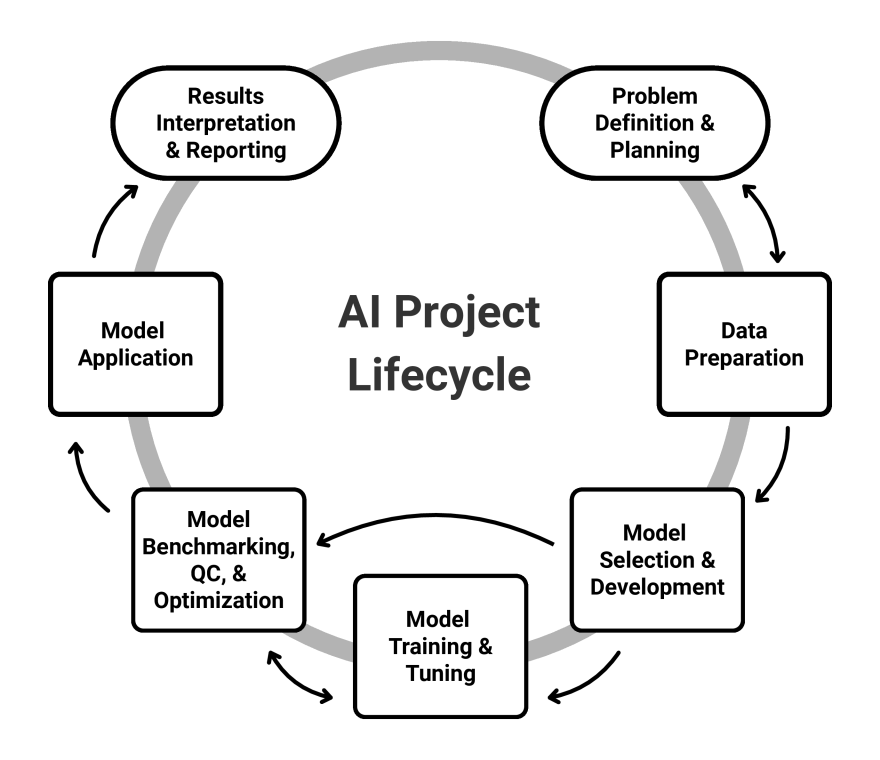
Figure 1: Conceptual illustration of AI project lifecycle stages from inception to completion.
The lifecycle stages
- Problem Definition and RCD Resource Planning
- Data Preparation
- Model Selection and/or Development
- Model Training and Tuning
- Model Benchmarking, Quality Control, and Optimization
- Model Application
- Results Interpretation and Reporting
- Cross-Cutting Considerations
-
Anna Alber, L. Briggs, Paul Brunk, M. Joshi, A. Kamble, A. Kefi, Timothy Middelkoop, Semir Sarajlic, Ana Marija Sokovic, Jeffrey Valdez, and Ying Zhang. Ai project facilitation guidance for research computing and data (RCD) professionals. In Practice and Experience in Advanced Research Computing 2025: The Power of Collaboration. ACM, 2025. doi:10.1145/3708035.3736061. ↩↩
-
Patrick Schmitz, Scott Yockel, Claire Mizumoto, Thomas Cheatham, and Dana Brunson. Advancing the workforce that supports computationally and data intensive research. Computing in Science & Engineering, 23(5):19–27, 2021. doi:10.1109/MCSE.2021.3098421. ↩
-
Timothy J. Boerner, Stephen Deems, Thomas R. Furlani, Shelley L. Knuth, and John Towns. ACCESS: advancing innovation: NSF's advanced cyberinfrastructure coordination ecosystem: services and support. In Practice and Experience in Advanced Research Computing 2023 (PEARC '23), 173–176. ACM, 2023. doi:10.1145/3569951.3597559. ↩
-
Katia Bulekova, Carolyn Casler, Erik Deumens, Jeremy Frumkin, Jill Gemmill, Karen Green, Kathryn Kelley, Glen MacLachlan, Michael Navicky, Alana Romanella, H. Birali Runesha, Semir Sarajlic, Dan Stanzione, and Kim Wong. The dynamic state of AI in research computing. 2024. Unpublished. doi:10.13140/RG.2.2.30956.58244. ↩
-
James J. Donlon. The national artificial intelligence research institutes program and its significance to a prosperous future. AI Magazine, 45(1):6–14, 2024. doi:10.1002/aaai.12153. ↩
-
National Artificial Intelligence Research Resource Task Force. Strengthening and democratizing the U.S. artificial intelligence innovation ecosystem: an implementation plan for a national artificial intelligence research resource. Technical Report, National Science Foundation and White House Office of Science and Technology Policy, January 2023. URL: https://www.ai.gov/wp-content/uploads/2023/01/NAIRR-TF-Final-Report-2023.pdf. ↩
-
Jason Bates. U.S. NAIRR pilot brings cutting-edge AI resources to researchers. National Science Foundation, 2024. URL: https://www.nsf.gov/science-matters/us-nairr-pilot-brings-cutting-edge-ai-resources-researchers. ↩
-
Campus Research Computing Consortium (CaRCC). AI facilitation interest group. \url https://carcc.org/ai-facilitation-ig/, 2025. URL: https://carcc.org/ai-facilitation-ig/. ↩
-
Glenn A. Bowen. Document analysis as a qualitative research method. Qualitative Research Journal, 9(2):27–40, 2009. doi:10.3316/QRJ0902027. ↩
-
Campus Research Computing Consortium (CaRCC). AI facilitation materials working group. \url https://carcc.org/ai-facilitation-materials-working-group/, 2025. URL: https://carcc.org/ai-facilitation-materials-working-group/. ↩
-
M. Joshi, A. Alber, L. Briggs, J. Garcia Mesa, A. Kamble, L. Michael, T. Middelkoop, S. Sarajlic, A. Sokovic, J. Valdez, and Y. Zhang. The ai project lifecycle: implementation strategies and tools. 2026. doi:10.5281/zenodo.19121611. ↩